
I’ve got two trades on at the moment that the big end of town isn’t going to be interested in. One of them is on borrowed time, and I’m a bit surprised it’s lasted as long as it has. But I’ll likely still be grinding away at the other one in ten years. Their similarities and differences make a decent case study in what works for the indie trader, and why.
The first is a simple arbitrage in crypto. It’s a high Sharpe, small dollars type of thing, and it requires understanding some plumbing quirks between crypto venues. I can’t give you the details of that one, because the day I do is the day it stops working. I’ll write about it when it dies, which is probably sooner rather than later, for reasons I’ll get into below.
The second is the end-of-month wealth management rebalancing trade that I’ve written about before.
I almost didn’t write this article because talking about good trades that you can’t share reeks of humble-bragging, and there’s no surer way to bring down the wrath of the market gods than to brag about one’s P&L. So I hope they, and you, don’t interpret it that way. Instead, it’s a case study in what’s realistic for people like us to go after, illustrated by the similarities between these two very different trades.
The shelf life of a trade
One way to sort trading edges is by whether they have a shelf life.
Some don’t. The classic example is a risk premium. Things like holding equities and selling insurance via options are uncomfortable, and you basically get paid for that discomfort. Such trades are unlikely to disappear - human risk preferences haven’t changed and aren’t likely to any time soon.
Another class of trade comes from people who are forced or willing to trade regardless of price. If they do it in enough size relative to that particular market, price can get pushed around in noisily predictable ways. Edges like that do tend to decay. How fast they decay largely depends on who can be bothered to actually trade them.
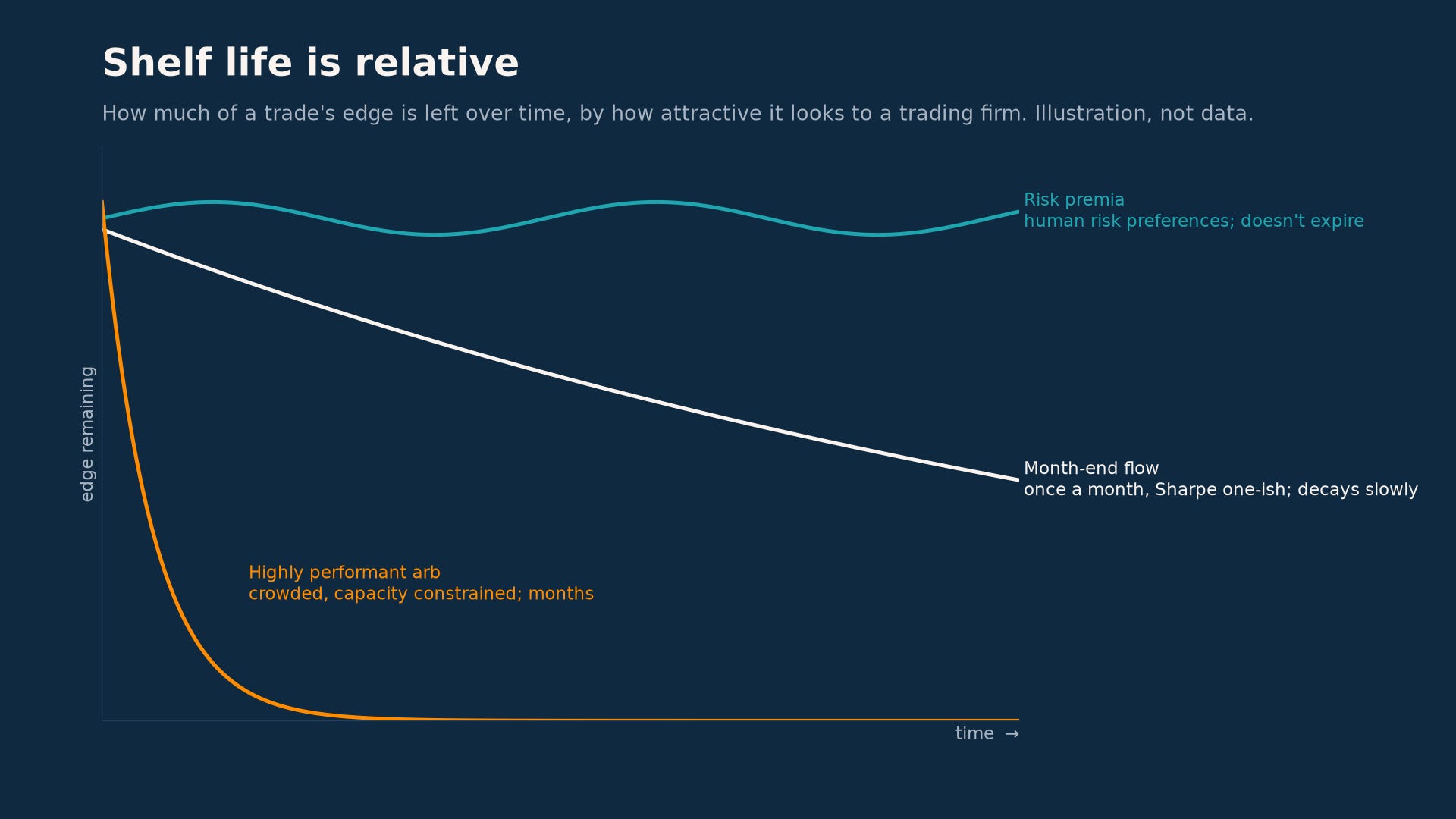
The month-end trade is my favourite example. Billions of dollars sit in funds with a fixed split between stocks and bonds. When stocks have a big month, those funds are mechanically overweight stocks, and their mandate says they have to sell stocks and buy bonds into month end. You can work out roughly what they’ll be buying and selling and get in front of it. Sometimes you can fade it as well.
It’s a decent trade. Sharpe over one, reasonably consistent.
Now look at it from a trading firm’s point of view. It comes around once a month and it doesn’t work every month. The Sharpe is one-ish. Something like that is a long way down the list for a firm, if they’re even aware of it. They are certainly not getting out of bed to put capital into it; they have better things to do with their money.
Put the crypto arb next to it. Nobody big wants that one either. The whole thing is worth maybe a few thousand dollars a day max, and I haven’t been able to squeeze it for even that much. A firm can’t put real capital into something like that. Number one, it’s crypto. Number two, it’s small.
So both trades are things I can do for exactly the same reason. The people with the resources to take them off me don’t want them.
That, to me, is the key to systematic trading as an indie trader. You have to pick the right games. It’s unreasonable to think we could beat the Jane Streets of the world with their resources and their armies of very smart people. But we don’t need to beat them, and we don’t even need to play the same games as them.
Unattractive - but for different reasons
Both trades are mine because the traders who could beat me to them don’t want them. The difference between the two is what the big players can’t be bothered with, and whether that thing can be fixed.
The crypto arb is too small for a firm. Sadly, it isn’t too small for people like me. Because it performs so well, other small operators will notice it soon enough, the ones who do will pile in, the few thousand dollars gets shared more ways, or the edge goes to whoever does it best, and then it’s gone. I’ll take it while it lasts. It’s not the sort of thing you build a retirement around.
The month-end trade isn’t a good use of a firm’s capital. It ties money up for days at a time, it comes around once a month, and month to month it’s not far off a coin flip. Nobody at a firm piles into that. The big money is constantly making judgements about what’s worth their time, and they’ll keep doing that. This trade is never going to make that list.
So a really useful question to ask of any trade is why doesn’t the big money want it. What sucks about it, from a trading firm’s perspective? The answer to that tells you whether you can compete at all.
Another good question is how well it performs, because that gives you a read on how long it’s likely to last. If it makes money most days, you can be sure that you’re on borrowed time. The crypto arb is small enough that the big players don’t want it, so you get a seat at the table. But it’s good enough that other small players will notice, start cutting your grass, and in no time at all, there’s nothing left.
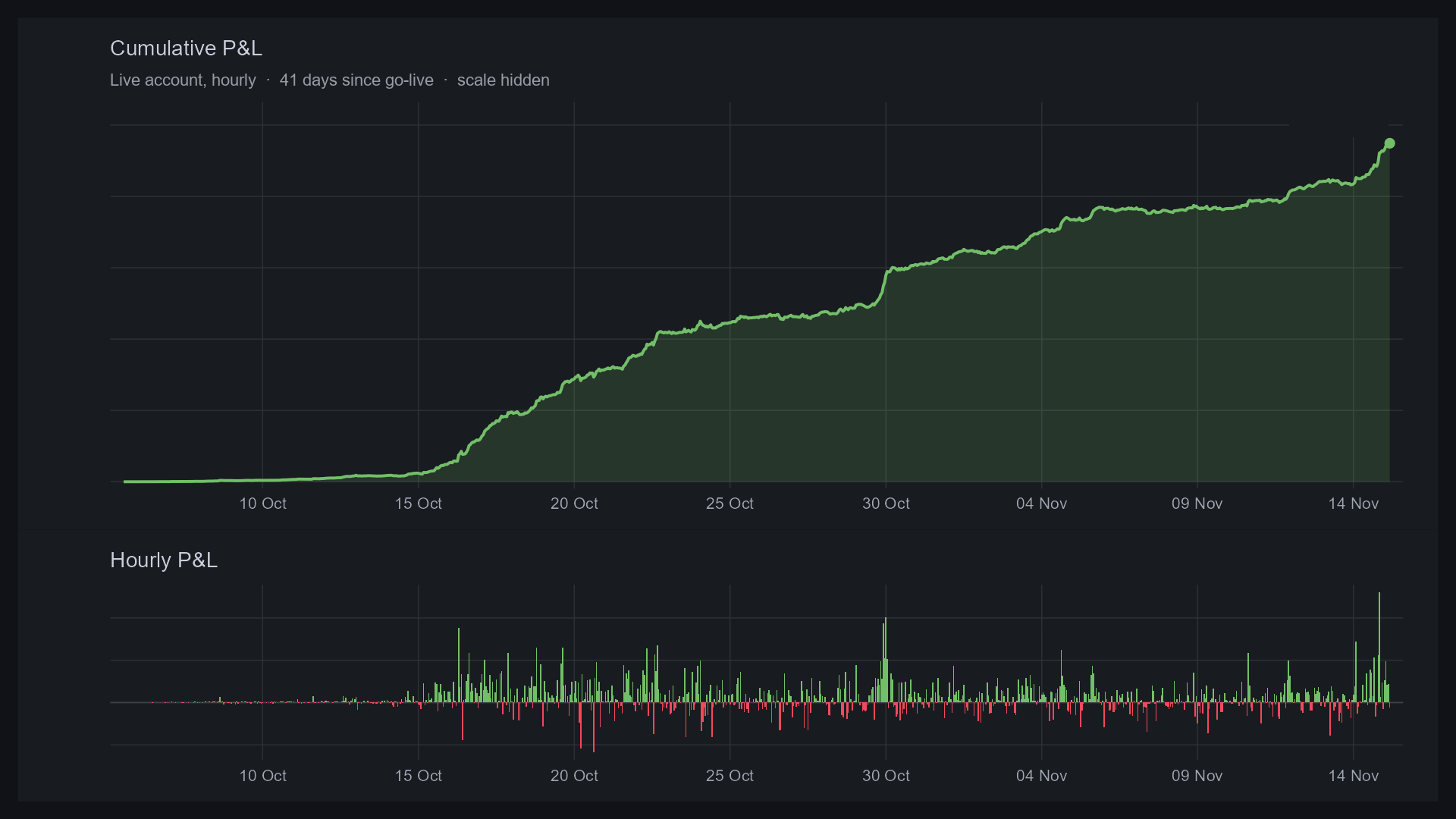
The P&L chart above is what borrowed time looks like. It represents six weeks of trading, hourly. I removed the dollar axis because it’s private and not relevant. The character of the P&L is the point. Something that goes up and to the right like that, making money most days, is exactly the kind of thing other small operators go looking for. It’s the sort of trade that you’re very happy to take when it comes around, but you can’t build a long-term sustainable trading business around it.
On the other hand, trades that are slow and lumpy and look mediocre on their own are the home ground for the indie trader. Five of those trades on five different mechanisms, running together, is a different animal from any one of them, and they’re likely to stick around long enough that you will have plenty of time to find their replacements when you need to.
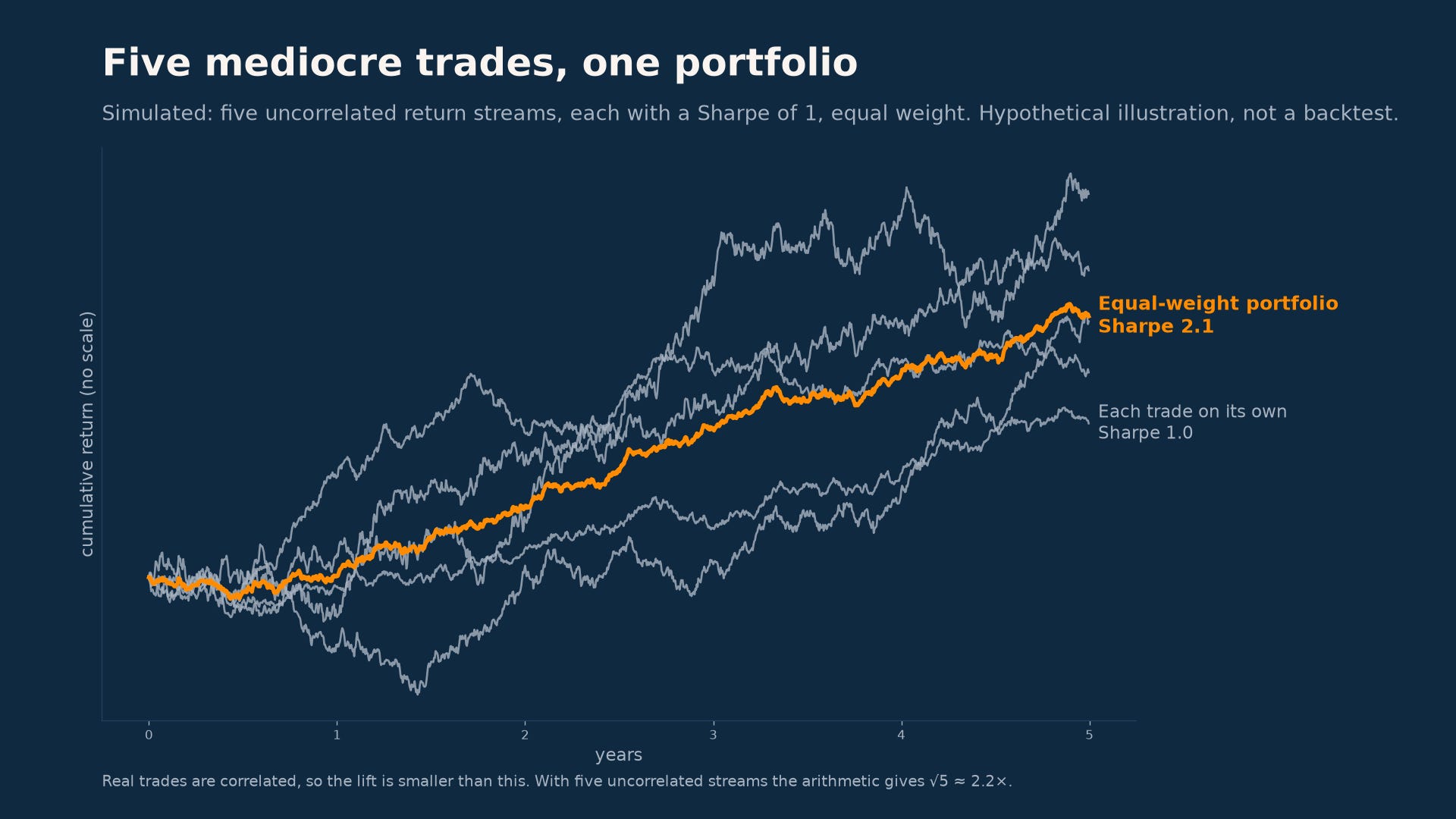
What makes a trade look unappealing to a professional is literally the moat that keeps it for you. If you’re a one-person trading operation, you want to be a specialist in boring. Take the occasional Sharpe 5 trade that lasts a month when the market gifts you one, and thank the market gods when it does.
The method scales
The process I used to find the crypto arb is the same one that I use to find the slow, boring stuff a solo trading business gets built on. There are four steps.
1. Mechanism first
Who is forced or willing to trade, when, and why aren’t they trading to maximise their own short-term returns? Examples include the rebalancing fund, the index tracker, the hedger. You should be able to say who’s on the other side of the trade and why. If you can’t, you probably don’t have a trade, you’ve got a pattern. The month-end trade obviously passes this test. So does the crypto arb; it’s a plumbing quirk between venues and I can tell you who’s on the other side.
2. Look in the data
Go and look for the effect in the data, but go in as a scientist trying to understand a phenomenon. The usual mistake is to reach straight for the backtest and confuse it for research. Instead, default to simple data analysis experiments that answer questions like:
Is the effect there at all?
Is it there in different decades, in different markets, with the obvious things taken out?
Does it get stronger when the mechanism says it should, like when the rebalances are big?
3. Be a grown-up
People call this trading psychology, but most of what gets written about that is nonsense. The version of trading psychology that has some practical use consists of nothing you haven’t had to confront if you’ve ever had any job at all. Firstly, be a grown-up about the research: when the data says no, it’s no, and you don’t go torturing the data until it says yes.
Secondly, be a grown-up about the job itself: put the orders in when the rules say they go in, at the size the rules say, and accept that bad months happen in trading. Have realistic expectations, and turn up, do the job, and do it well, just like you would do in any job.
That’s about all there is to trading psychology. Except perhaps for dealing with the constant regret - you either shouldn’t have done the trade or you should have done it bigger - but that’s a story for another time.
4. Build the portfolio
Any one of the trades you can build an indie trading business on is mediocre by definition. A handful of them on different mechanisms, running together, is what makes the exercise worthwhile, and that’s what the Sharpe-one trades are for. Don’t make the mistake of thinking you need one super high-performing unicorn trade, because they’re really hard to find, and when you do find one, it won’t last, so you can’t build the business around it anyway. Five ordinary trades on five different mechanisms will do.
If you want the long version of how I went from engineer to professional trading to running my own solo trading business, including the strategy that nearly ended the whole thing before it even started, there’s a free case study here. It’s mostly about the mistakes, so you don’t have to make them the way I did.
Sat on the firm side of this for years and you're right, nobody there gets out of bed for a once-a-month Sharpe 1.
One thing I'd add from that side. A firm pays less for the same fill than you do. Part of that you can close, being good at execution is learnable. Part you can't, the fee tier comes with volume and no amount of skill gets you there.
So boring is a moat, yes. I'd just be careful with the tiny arb, when the edge is small the fee is most of the trade.