
This was early in my trading journey.
I’d built what I thought was a clever automated strategy: a breakout system that traded currency pairs based on overnight ranges and longer-term trends.
The details don’t really matter.
What matters is that I’d spent weeks tinkering with the backtest until the equity curve looked beautiful.
Stop losses, take profit levels, trailing stops, time stops, filters of various kinds. I tortured that thing until it confessed to profitability.
Then I went live.
The Lucky Disaster
On the first day, my strategy placed trades while I was away from the computer. When I checked my phone, I nearly had a heart attack. My positions were 10x bigger than I’d intended. I’d messed up my sizing algorithm.
I rushed home to fix things.
And when I got there, I found that I was actually up. Way up.
So what did I do? I thought, “I’m playing with the house’s money now. Let me just ride this out.”
That’s pure gambling irrationality.
Somehow, I didn’t blow up. I closed those oversized positions with a massive win. Then I sized things down to what I’d originally intended (which was still way too big, but I didn’t realise that either) and carried on.
And the strategy kept making money.
For the next four months, I watched my account climb. 50%, then 100%, then 150%. I felt invincible.
The Inevitable Reckoning
You can probably guess what happened next.
The strategy started losing money just as consistently as it had been making it. Day after day, week after week, the gains bled away.
I checked my code for bugs. I re-optimised parameters. I verified that my live performance matched my backtest over the same period.
Nothing explained it.
Eventually, I sized down further (funny how losing money makes you suddenly sensible about position sizing) and kept trading. But the losses continued. Death by a thousand cuts instead of a sudden explosion.
After four more months, I admitted defeat and turned it off.
What Actually Happened
Years later, I went back and looked at what I’d been trading. Turns out, my “clever” breakout system was just a very convoluted trend-following strategy.
Here’s a chart of the US Dollar Index during that period. The blue shading is when I made money. The red shading is when I lost it:
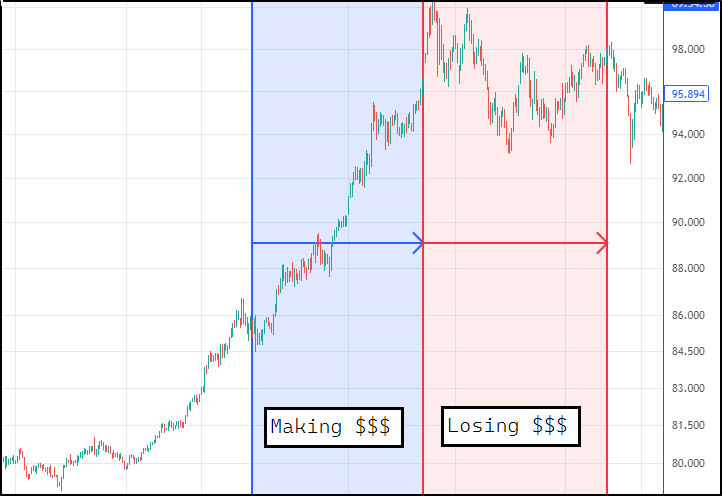
The dollar was in a roaring uptrend when I went live. My strategy, which was essentially just “buy things going up,” made money because things were going up.
Then the market went sideways. And I lost money trading trend while the market wasn’t trending.
I’d spent so much time messing about with entry rules and exit rules and stop losses that I never stopped to ask: “Is the underlying idea actually good?”
The underlying idea was that currencies trend. Do they? A quick look at the autocorrelation of dollar returns shows... basically nothing:
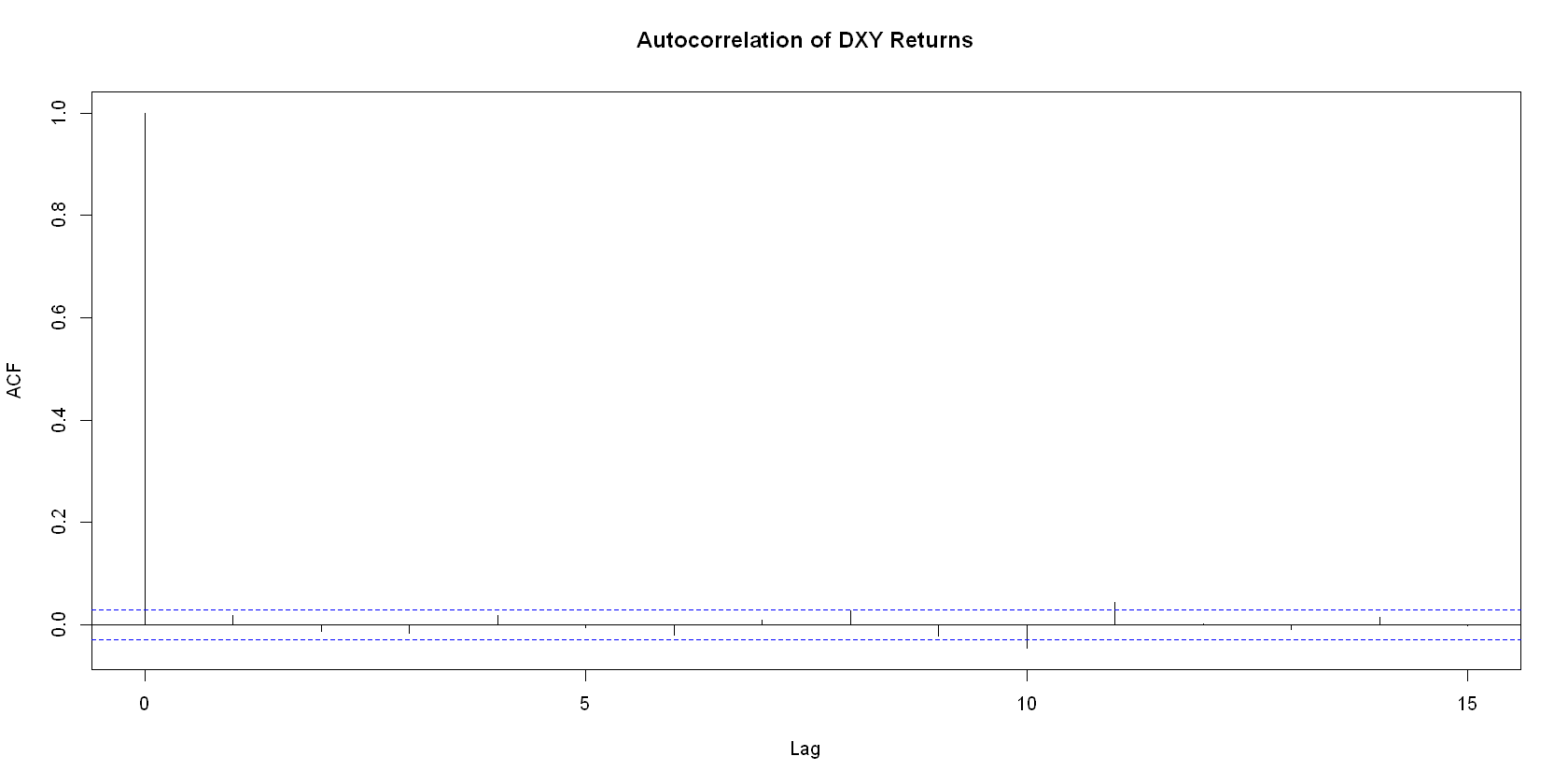
No persistence. No trend. Random noise.
I got lucky. I happened to start trading a trend strategy on one of the few occasions when the market actually trended.
The Lessons
Trading too big nearly ended me before I started. If those initial 10x positions had gone against me instead of for me, I’d have been wiped out within hours of pushing go.
Your P&L is a terrible feedback mechanism. When your only signal is “am I making money or not,” you have no way to distinguish luck from skill. Even with a real edge, you can be underwater for months. Without one, you’re just gambling.
Backtesting is not research. I tortured my backtest until it showed me what I wanted to see. That says nothing about whether the underlying idea is sound.
Ask the right question. Instead of “Do these rules make money in a backtest?”, I should have asked “What needs to be true for this to work?” For a trend strategy, markets need to trend. Do they? That’s something you can test directly.
I got very lucky with that first strategy. Lucky enough to survive and learn some important lessons.
Most people don’t get that lucky. And the lessons end up being a lot more expensive.
This is an excerpt from my case study on building a trading career as a finance outsider. If you found this useful, you can download the full case study here.